Map the surroundings
List magnet-sensitive instruments and their location relative to the closed and open flap.
Application / outdoor equipment & soft carrying systems
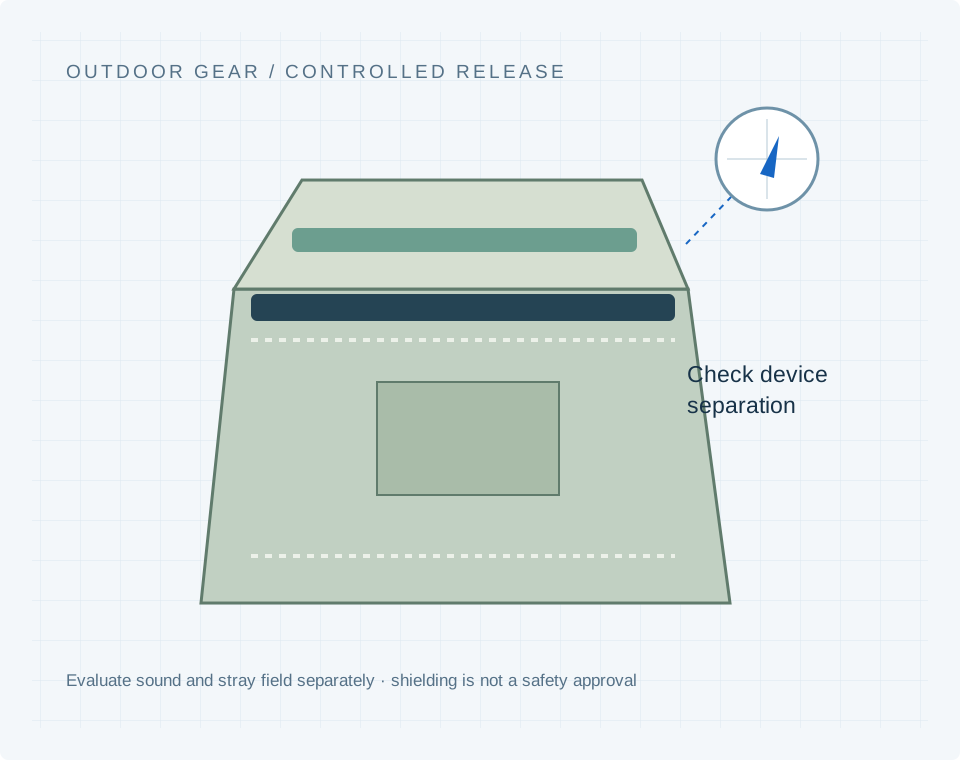
Develop a fabric-covered flap for deliberate, low-noise access. Evaluate sound, handling, retention and magnet-sensitive equipment as separate requirements.
OEM components · matched A/B constructions · project-specific review
Application priorities
An optical-equipment pouch or outdoor organizer may need controlled access with gloves and a loaded bag. The noise comes from the entire action: lining friction, flap movement, magnetic contact and any secondary hardware.
Compare the proposed magnetic flap against the user’s actual opening motion. Locate a grasp tab, manage contact surfaces and check whether the flap can close fully when the pouch is full. A quiet opening on an empty bench sample can behave differently in use.
Magnetic field considerations remain separate. Compasses and other sensitive equipment may require separation, a different layout or a nonmagnetic closure. A shielding layer is a design proposal to assess, not proof of zero interference.
Start here
A focused selection framework
Use the finished garment or bag as the test specimen. A bare magnetic strip is only one part of the result.
| Decision | What to evaluate | What to record |
|---|---|---|
| Handling | Glove thickness, grip point and opening direction | Whether the user can open and reclose deliberately. |
| Sound | Fabric rub, contact and release in a repeatable action | Microphone distance, ambient level and comparison sample. |
| Retention | Loaded flap, compression and accidental pulling | Load direction, permitted movement and opening force. |
| Equipment compatibility | Actual device, distance, orientation and closure states | Device response and any required separation. |
| Environment | Dust, moisture, temperature and repeated use | Conditioning method and changes in handling or enclosure. |
Your sample request
Integration & qualification
List magnet-sensitive instruments and their location relative to the closed and open flap.
Include the padding, lining and stiffener that determine the gap and closing sound.
Use the real gloves and load. Record sound, opening direction and repeated handling separately.
Continue only if both handling and compatibility requirements are met. Select a nonmagnetic alternative where needed.
Construction shortlist
01 / MZS-InterlockProfile-assisted retention
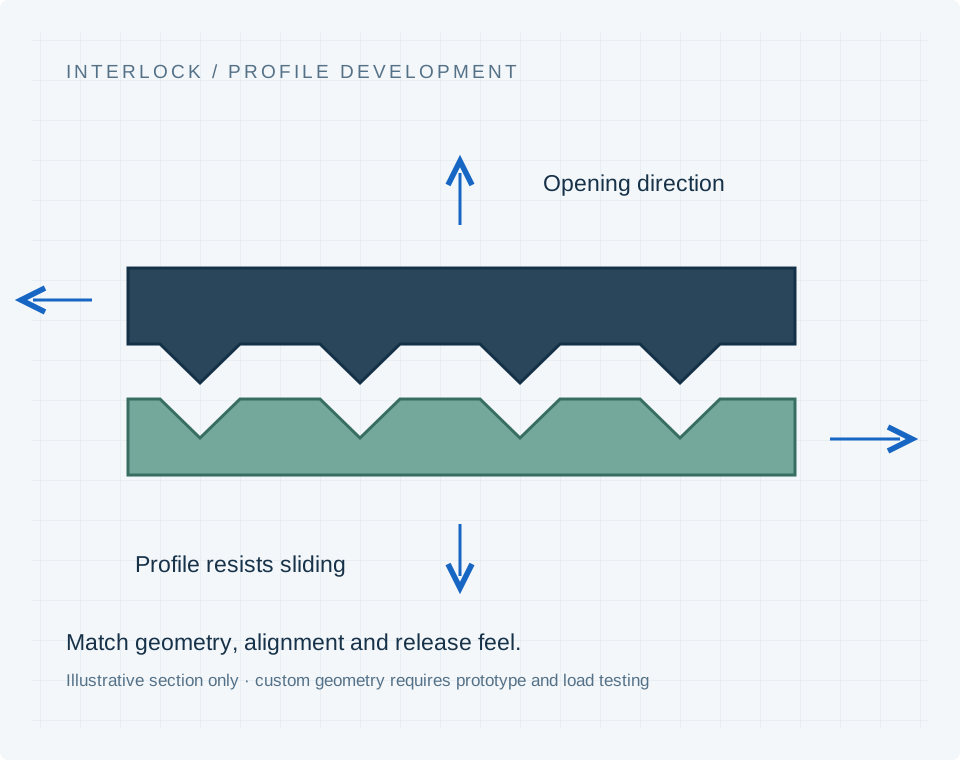
Explore shaped mating surfaces when lateral movement matters as much as closing force.
Explore the construction02 / MZS-SilentTacQuiet outdoor closure development
Develop the flap feel, sound and equipment separation together for outdoor carrying systems.
Explore the constructionBuyer questions
No. Fabric movement and contact can still make sound. Specify an opening action, measurement distance and ambient conditions if an acoustic target matters.
No universal distance or deviation value is published. Test the actual device, closure layout, orientation and operating states together.
No implanted-device suitability is established. Follow the device manufacturer’s guidance and the wearer’s healthcare professional’s advice. A shielded construction is not a medical clearance.
State that condition in the first brief. A nonmagnetic mechanical or textile closure may be the correct choice rather than trying to infer compatibility from a shielded magnetic sample.
Describe the flap, fabric stack, expected load, gloves and adjacent equipment. The proposed construction, sample contents and qualification work are then agreed for the project.
R&D sample selection
Share the opening length, fabric stack and intended use. Discuss a paired sample selection before committing to a production specification.
Sample contents, availability and shipping are confirmed for your project.