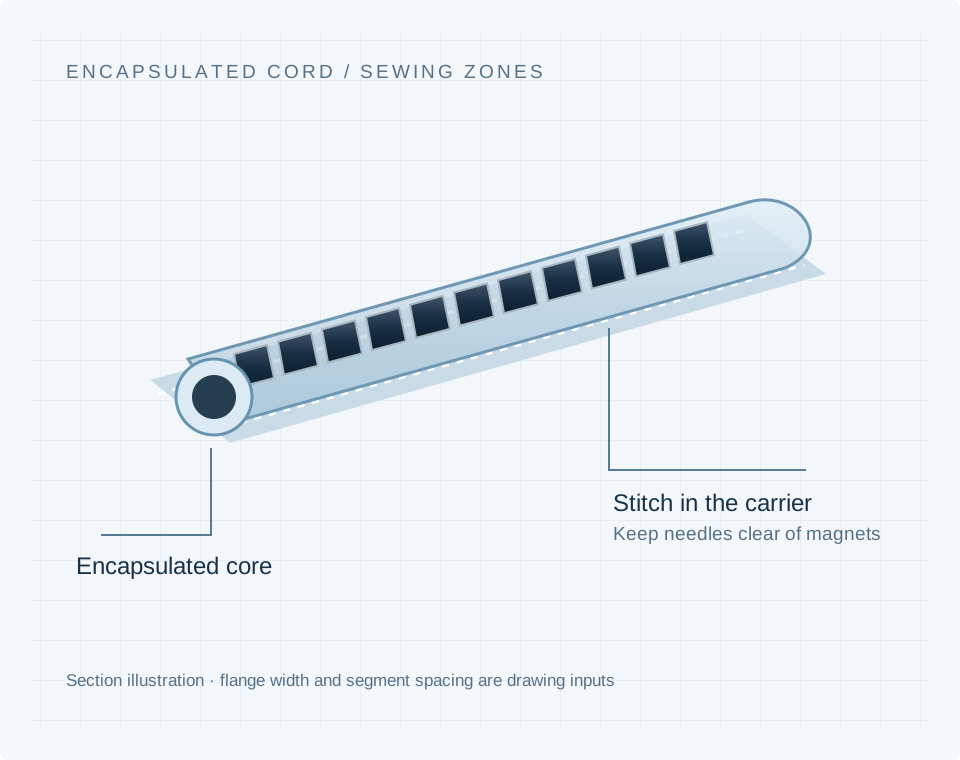
Map the safe stitch zone
Show the core envelope, seam line and carrier clearance. Do not allow a needle to strike a hard magnet.
Engineering / drawing & integration framework
A useful specification describes the complete paired closure: magnetic core, carrier, fabric gap, cut ends and the loads it needs to handle.
OEM components · matched A/B constructions · project-specific review
01 / drawing inputs
Use millimetres for dimensions and identify the finished fabric stack. Catalogue material alone does not define the installed closure.
| Parameter | What to specify | Verification on the sample |
|---|---|---|
| Magnetic core | Material or grade, core shape and magnetic thickness | Match the declaration and section to the approved sample. |
| Overall section | Total width, thickness, carrier width and tolerances | Measure the complete assembly, including enclosure and backing. |
| Finished length | Opening length, active magnetic length and cut tolerance | Distinguish the active closure from inactive end allowance. |
| Fabric stack | Layer count, reinforcement and compressed gap | Measure the actual material between the matching surfaces. |
| Flexibility | Working bend radius, fold positions and drape requirement | Check both open and closed configurations. |
| Carrier or enclosure | Material, joining route and edge/end detail | Check seam distortion, exposed elements and retention. |
02 / matched magnetic circuit
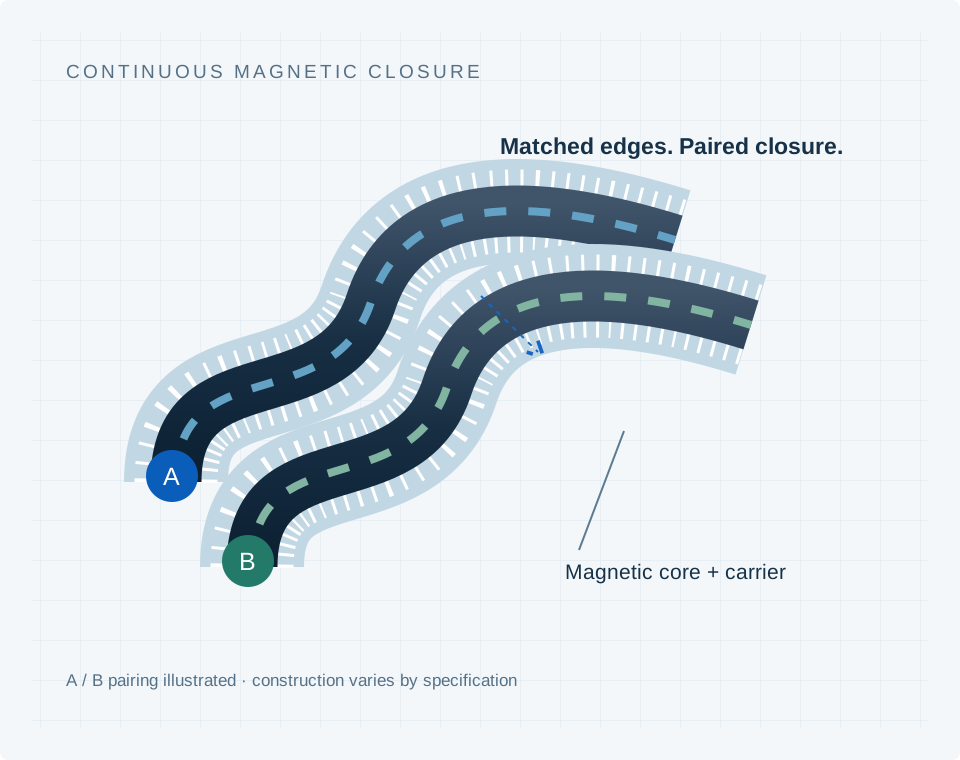
Identify the magnetic face, pole pattern and feed direction for both sides. If the selected construction uses multipole magnetization, record the pitch and the matching orientation rather than assuming any two strips will align.
For a segmented enclosure, identify element positions and permitted cut gaps. For continuous stock, define the cut and finishing process. Preserve pair labels through winding, cutting, storage and sewing.
03 / factory integration
Approve an integration drawing and work instruction for the selected construction. A universal flange width or stitch setting cannot cover every core, carrier and fabric.
Show the core envelope, seam line and carrier clearance. Do not allow a needle to strike a hard magnet.
State allowed cut locations and the approved end closure. A cut sleeve must not leave an escape path for internal elements.
Control A/B orientation, feed tension, alignment and restraint. Check that the seam does not distort the contact face.
Review fixtures, magnetic attraction to equipment and the factory’s detection process with the responsible production and quality team.
04 / load cases
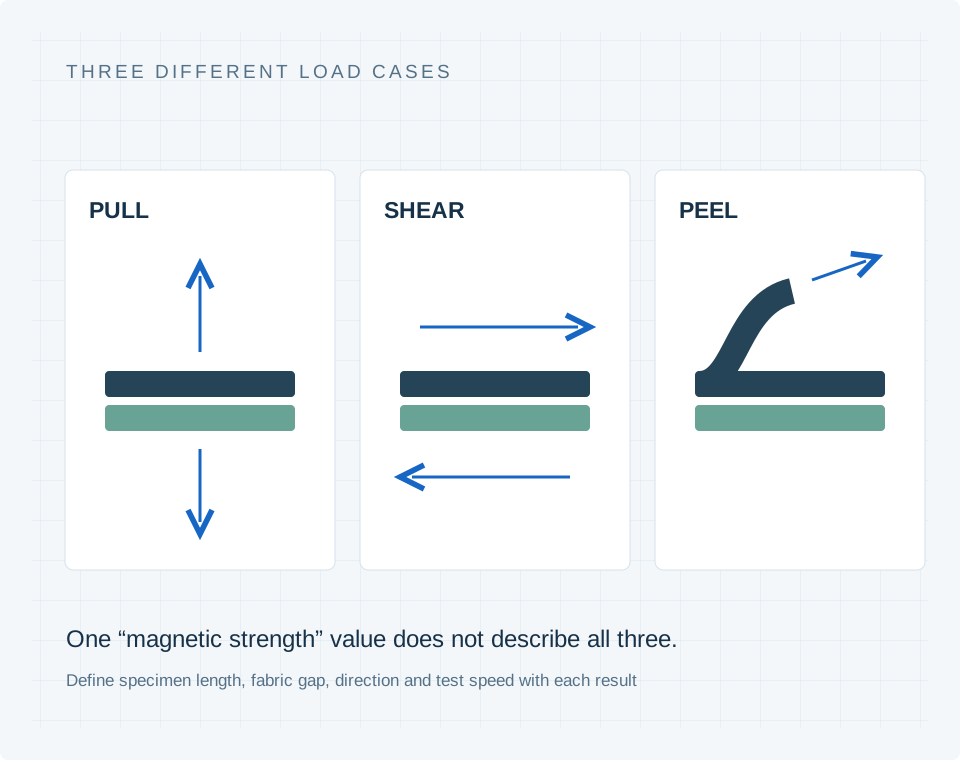
State the specimen length and width, fabric gap, fixture, loading direction and speed with every force result. Record displacement as well as peak force when lateral movement matters.
A zipper strength method may inform a test plan, but its applicability to a toothless magnetic assembly must be assessed. Refer to the selected method and test report rather than asserting equivalence from a headline force number.
Review the qualification matrix →| Evaluation | Define in the plan | Record after conditioning |
|---|---|---|
| Normal separation | Specimen geometry, fabric gap and pull direction | Force, separation mode and enclosure condition. |
| Lateral retention | Direction, restraint and permitted displacement | Slip, local separation and the load path through the seam. |
| Peel opening | Grip point, peel angle and opening speed | Usable opening force and damage to the fabric. |
| Open/close cycles | Action, number of cycles and inspection interval | Changes in alignment, release feel and encapsulation. |
| Washing and drying | Care process, detergent, temperature and cycles | Dimensions, retention, appearance and exposed elements. |
| Outdoor exposure | Relevant moisture, temperature, debris and corrosion conditions | Function and enclosure condition in the intended environment. |
05 / procurement definition
| Quotation field | Confirm before ordering |
|---|---|
| Unit | One strip, one metre of each side, or a complete A/B pair. |
| Supply format | Roll length or cut-length pairs; joint allowance and end finishing. |
| Sample release | Section revision, pair labels, measured sample record and agreed test scope. |
| Packaging | Pair separation/identification, winding direction, lot label and handling requirements. |
| Commercial scope | Material, quantity, tooling, sample cost, freight, lead time and shipment terms. |
A structured project brief covering the opening, material stack and quantity.
Download .txtRecord specimen details, conditions and acceptance criteria before testing.
Download .txtA/B orientation, stitch clearance, cut ends and production release questions.
Download .txtBuyer questions
The construction routes cover different materials, carriers and sections. Request the dimensioned drawing and measured results for the proposed sample instead of applying one generic number to every assembly.
You can state it as a requested target together with the measuring conditions. Feasibility and the relationship to the required installed closing action need review; the website does not publish that range as a verified universal product specification.
Specify the actual care or exposure requirement, material and specimen construction. Ask for a report that identifies the tested sample, method, conditions and results. A material label or generic certificate cannot replace that match.
Yes. Include the section or opening drawing, actual material and expected volume. Prototype work, tooling, qualification and production scope should be agreed separately.
R&D sample selection
Share the opening length, fabric stack and intended use. Discuss a paired sample selection before committing to a production specification.
Sample contents, availability and shipping are confirmed for your project.