Zipper strength
ASTM D2061 covers strength test methods for zippers. A toothless strip requires a considered method selection, fixture and applicability review; no automatic zipper-class equivalence is claimed.
ASTM D2061 record →Engineering / qualification planning
A test method, a material declaration and a finished-product approval answer different questions. Build a qualification plan around the actual garment or bag.
OEM components · matched A/B constructions · project-specific review
Qualification matrix
The table below is a planning framework. It is not a list of MagZipStrip certificates or claimed test passes.
| Question | Relevant evaluation | Evidence to request |
|---|---|---|
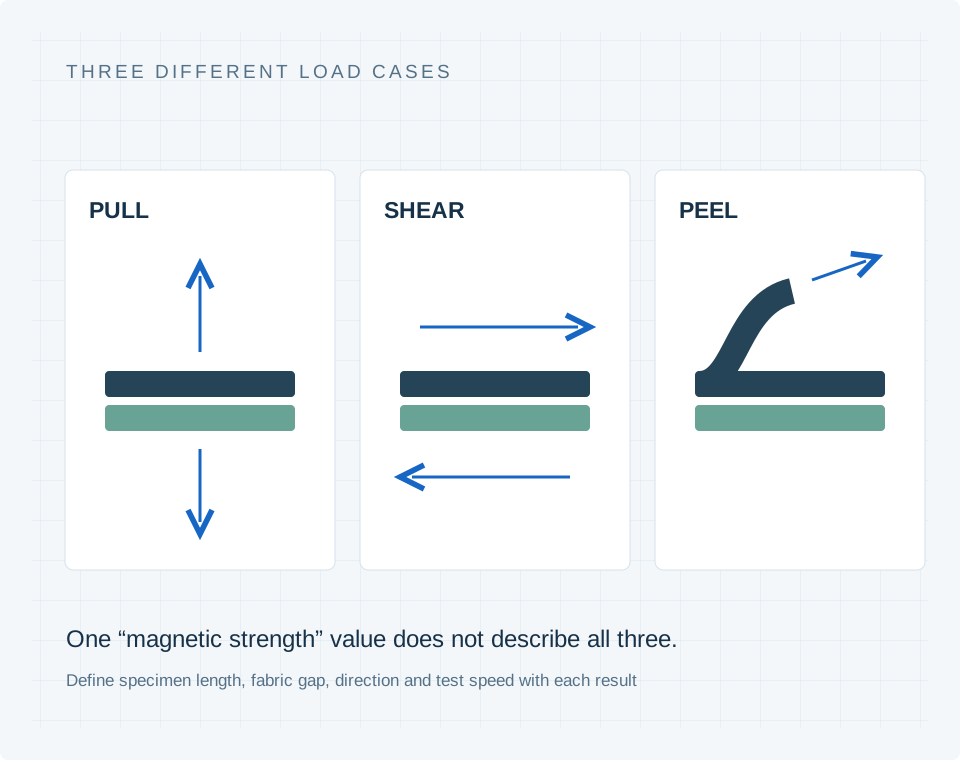
| Will it stay closed? | Normal separation, lateral movement and peel opening on the real assembly | Geometry, fabric stack, fixture, direction, speed and observed failure mode. |
| Will it survive use? | Repeated opening, bending, enclosure and seam retention | Cycle method, inspection intervals and before/after condition. |
| Will it tolerate the care label? | The garment’s specified washing and drying procedure | Specimen identification, procedure, temperature, drying and dimensional/functional results. |
| Will it tolerate outdoor exposure? | Application-relevant moisture, temperature and corrosion assessment | Exposure conditions, duration, enclosure inspection and functional results. |
| Is the material acceptable for the market? | Applicable chemical and material requirements for the intended use | Sample-linked declarations or reports with scope, dates and issuing body. |
| Is the full bag water-resistant? | Finished-product leak or water exposure assessment | Whole-bag construction, exposure conditions and applicable rating/report scope. |
Method context
ASTM D2061 covers strength test methods for zippers. A toothless strip requires a considered method selection, fixture and applicability review; no automatic zipper-class equivalence is claimed.
ASTM D2061 record →ISO 6330 describes domestic washing and drying procedures for textile testing. Specify the selected process and cycles; citing a procedure is not evidence that a closure has passed it.
ISO 6330 record →Check that a declaration or laboratory report matches the supplied material, colour, enclosure and intended use. Certification marks and report claims need traceable scope and validity.
Discuss your evidence requirements →Application safety
Assess the enclosure, seam and cut ends against foreseeable damage and use. Children’s products need a dedicated review; magnetic elements must not become accessible through a failed seam.
CPSC identifies serious injury risk from magnet ingestion. Seek immediate medical attention if magnet ingestion is suspected.
CPSC magnet guidance →Magnetic fields can affect certain implanted medical devices. Follow the device manufacturer’s instructions and involve the wearer’s healthcare professional in suitability decisions.
FDA’s consumer-electronics guidance explains the interference issue. It does not establish a safe distance or approval for this closure.
FDA magnet-interference context →Evaluate the actual equipment, closure position, orientation and separation. A shielded drawing or a low field reading at one point cannot establish universal compatibility.
Where the equipment requirement excludes magnets, consider a nonmagnetic closure route.
Outdoor equipment guide →Procurement release
Use the same sample identifier on the drawing, test plan and report. Agree who approves the finished product, including labelling, market requirements and the final integration process.
Custom geometry and another supplier’s branded system are not interchangeable. No patent non-infringement or freedom-to-operate assurance is made by this website. Arrange a project- and market-specific review with qualified counsel where needed.
USPTO patent-management context →Prepare your review
A blank worksheet for the specimen, conditions, result and approval.
Download .txtEnclosure, intended user, magnetic surroundings and label-review questions.
Download .txtControlled stitching, pair orientation, cut ends and release records.
Download .txtTechnical content reviewed 19 October 2026. These original worksheets are planning tools, not laboratory certificates or pre-approved product labels.
Buyer questions
Request the documents relevant to the selected sample and its intended market. The availability and scope of existing material declarations or test reports are confirmed for that project; no universal certificate pack is promised.
No. A test method describes a procedure. A report identifies a specimen, conditions and results. A certification claim requires its own valid scope and authorisation.
Use them to prepare questions for the responsible product team. Final warnings, care instructions and market requirements must match the finished product and its intended user; the download is not a pre-approved label.
R&D sample selection
Share the opening length, fabric stack and intended use. Discuss a paired sample selection before committing to a production specification.
Sample contents, availability and shipping are confirmed for your project.